US President Election and Powers

Introduction:-
The US Presidential Election takes place every four years on the first Tuesday in November. Candidate must be
• at least 35 years old,
• born in the United States and
• lived in the US for the previous 14 years in order to be eligible.
Traditionally, candidates make their intention to run for President public in the year before the election takes place. Since there is no national authority which conducts the elections, local authorities organize the election with the help of thousands of administrators. 

Presidential primaries and caucuses 
The election process starts with the primaries and caucuses in January or February of the election year. 

1. Primaries are organized by state and local authorities using a secret ballot to cast votes for hopeful presidential candidates from each of the major parties. (34states)
2. Caucuses are private events organized by political parties themselves. Here, voters decide publicly which candidate they prefer. Afterwards, organizers count the votes and calculate how many votes each candidate receives. (16 states)

Delegates
Each state, the District of Columbia and some US territories are allocated a number of delegates, usually determined by population size. These delegates represent their state in the national party convention and vote to decide each party’s presidential candidate. 

There a two main types of delegates: 

1. pledged delegates – who have to support the candidate to whom they were assigned in a primary or caucus
2. unpledged or superdelegates – who can choose freely which candidate they would like to support

National conventions

The national convention of each party is held in the summer of an election year. A majority of delegates’ votes is needed to receive the nomination of the party, which is often already reached and known before the national conventions take place. If no majority is reached, the national convention is where the presidential candidate will be selected. 

General Election campaigning

After the nominee for each political party have been chosen, the presidential candidates go head-to-head campaigning throughout the country. They go on rallies and take part in debates to win the support of voters across the nation. Moreover, they explain their plans and views to society. 

Electoral College

On Election Day, voters go to the polling place and cast their vote for their prefered candidate. The voters elect their President and Vice President indirectly. Both are chosen by electors through the Electoral College process. 
States are allocated electors based on the number of seats they have in the House of Representatives and Senate. In total there are 538 electors (435 House of Representatives seats + 100 Senate seats + 3 for Washington D.C.). After ballots have been cast, all votes go to a statewide tally. Washington D.C. and 48 states use the winner-takes-all procedure where the election winner receives all the electors in that state. Maine and Nebraska are the exceptions because they have a proportional system. A candidate has to “win” at least 270 electors in order to become President. Voting at the Electoral College takes place in the weeks after Election Day the winner is usually always announced on the night of the election. 

Inauguration Day

Inauguration Day takes place on January 20 at the U.S. Capitol building in Washington D.C. First, the Vice President is sworn in, followed by the President. Both officially become President and Vice President after reciting the oath of office which has been used since the late 18th century. 

Powers of President of USA :-
The powers of President of USA could be divided into two parts:-
1. Formal Powers
2. Informal Powers
Formal powers of the president
1. Executive- 
Take care that the laws be faithfully executed.
• Nominate officials (with Senate confirmation).
• Request written opinions from administrative officials.
• Fill administrative vacancies during congressional recesses.
2.    Foreign policy
•  Act as Commander in Chief of the armed forcesMake treaties (with Senate ratification)
• Nominate ambassadors (with Senate confirmation)
• Receive ambassadorsConfer diplomatic recognition on other governments.
3.    Judicial
Grant reprieves and pardons for federal offenses (except impeachment)
• Nominate federal judges (with Senate confirmation)
4. Legislative
Recommend legislation to Congress.
• Present information on the State of the Union to Congress.
• Convene Congress on extraordinary occasions
• Adjourn Congress if House and Senate cannot agree .
• Veto legislation (Congress may overrule with supermajority)

Informal powers of the president

1. Bargaining and persuasion- Setting priorities for Congress and attempting to get majorities to put through the president’s legislative agenda.
2. Issuing executive orders- Regulations to run the government and direct the bureaucracy
3. Issuing signing statements- Giving the president’s intended interpretation of bills passed by Congress.
4. Negotiating executive agreements- Agreements with heads of foreign governments that are not ratified by the Senate.
Salient Features of US Constitution

Although there are many interesting features in its constitution but the most important are:

1.      Written Constitution:

First prominent feature of the American constitution is that unlike the British Constitution, it is written or documentary .It is very brief document and contains about 4000 words and at least 10—12 pages. It consists of preamble and seven articles only. Three of the articles are related to structure and powers of Legislative (Article 1), Executive (Article 2) and Judiciary (Article 3) and the other four dedicated to position of states (Article 4), modes of amendments (Article 5), 
supremacy of national power (Article 6) and ratification (Article 7). It also holds that constitution is the supreme law of the land. Article one is the longest and cannot be amended. Like other constitutions, it also consists of preamble; a single sentence that introduces and defines purpose of the document.

2.      Rigid Constitution:

Another feature of the American constitution is that it is rigid, which means that it cannot be amended by the congress by the ordinary procedure. The procedure is very  difficult. The procedure to amend Constitution consists of 2 steps;

a.    Proposal for Amendment:

There are two ways to propose for amendment. Either two-third (67%) of both the houses (Senate and House of Representatives) shall propose for amendment to constitution or on the application of legislatures of two-third (67%) states shall call a convention for proposing amendment.

b.     Ratification of Proposal:

The amendment shall be ratified by the legislatures of three fourth (75 %) of all states or by the convention of three fourth of  states. 

3. Popular Sovereignty:

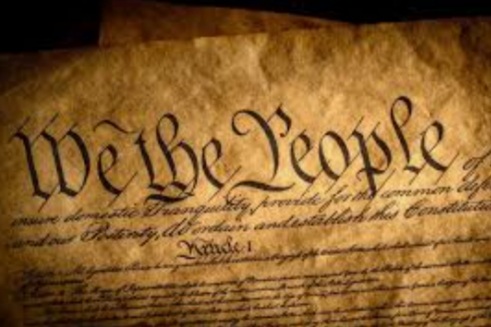
The U.S constitution establishes the popular sovereignty of the people. This means in U.S, the people rule i.e. they have delegated their powers to the government and the government owes its authority to the will of the people. The principle of popular sovereignty is stated in the Preamble of constitution as “we the people do ordain and establishthis constitution for United States of America.”This means that the ultimate seat of authority in United States is the American people.

4. Bicameral Legislature:

The constitution of USA provides for bicameral legislature. According to Article 1, “All legislative powers are vested in Congress.” In United States, congress is the parliament, which consists of two houses; House of Representatives and the Senate. House of Representative is regarded as the Lower House and the Senate is the Upper House.

5. Separation of Powers:

American constitution is based on the principle of “separation of powers”.  The main power of the country is divided in 3 branches i.e. the legislature,  the executive and the judiciary. 

6. Checks & Balances:

The framers of the U.S constitution were aware that a department, if left unchecked, would become oppressive. They; therefore, introduced checks and balances in the constitution. The separation of powers confirms the system of Checks and Balances. This system prevents misuse of powers. The powers are provided in such a way that it provides a check upon other institutions.

7.  Judicial independence:

The direct consequence of separation of powers is the doctrine of judicial independence. In United States all the judicial powers are enjoyed by the Supreme Court and other federal courts, no other office can influence its independence.

8.  Federal System:

The U.S constitution provides for a federal system of government. Federalism is a device by which independent states form a union without losing their identity. According to Article 1, the federal government has jurisdiction over 18 matters and residuary powers are vested in states. States are autonomous bodies and centre cannot interfere in their affairs. In case of conflict, Supreme Court decides or settles the I dispute.

9. Presidential System:

The constitution provides for a presidential form government. Article 2 provides the powers, election and their matters related to president. President is elected for a term of 4 years and is not answerable to Congress and cannot dissolve Congress. He has a cabinet to assist him in running his executive powers.

10. Republicanism:

The constitution calls for a republican system with President as elected head of the state. The constitution derives its authority from the people and is supreme law of the land. Neither centre nor states can override it.

11. Fundamental Rights and Liberty:

Another important feature of the American constitution is that it ensures certain fundamental rights for everyAmerica citizen. He cannot be deprived of these rights by any lawful authority. The first ten amendments to the constitution are called “Bill of Rights”. The Bill Of Rights provides for the rights of a person’s property, liberty, freedom of speech, press, religion and assembly.

12. Dual Citizenship:

The constitution provides for dual citizenship i.e every American citizen is entitled to the right of dual citizenship. First of all, he is the citizen of Americaand secondly he is the citizen of that state in which he lives. The feature of dual citizenship was introduced in the American constitution by the 4th amendment.

13. System of Spoils:

When a president is elected, he does appointment of public offices. If in elections, the President is elected who is of the opposition party, he dismisses the public office bearers and makes fresh appointments. Under this system, a civil servant intend by one president on political consideration cannot claim his office when an opposition President secures victory in polls.

14. Judicial Review:

ate important feature of the American constitution is the power of judicial Review. The Supreme court in U.S is supreme not only in theory but also in practice. Iu U.K no court can challenge the power of Parliament; however in United States all the laws passed by the congress and state legislatures are subject to judicial review.